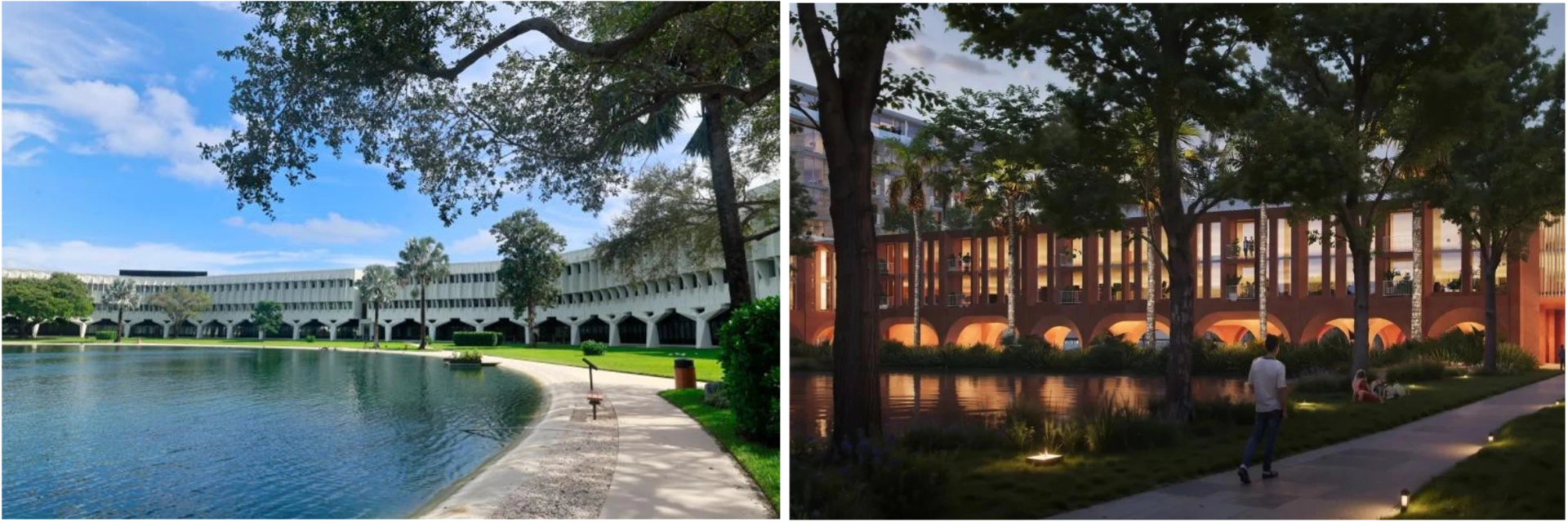
A massive property in Boca Raton is pictured to become a South Florida destination, set to one day offer nearly 1,200 homes, a village of shops and restaurants, public art, and event spaces for a variety of entertainment offerings.
The changes are expected for the Boca Raton Innovation Campus, the former IBM hub located at 5000 T-Rex Ave., not far from Interstate 95 and Yamato Road.
Now, developers behind the 1.7 million-square-foot campus are providing more specifics about what’s to come in the next several years. Reshaping the campus is a large task, so it’s being done in phases through the years.
Terra, a South Florida-based real estate company, has been selected to develop the parts of the campus that don’t yet exist, such as the residential and the retail components.
“I’ve always been interested in trying to find a campus feeling like this,” Terra CEO David Martin told the South Florida Sun Sentinel. “The whole idea of having a happier, better place to work, a happier, better place to live, and being able to walk to amazing amenities and facilities, I think is a very unique opportunity.”
Here’s a deeper look into how the campus, also known as BRiC, plans to create that environment.
Sequence 1
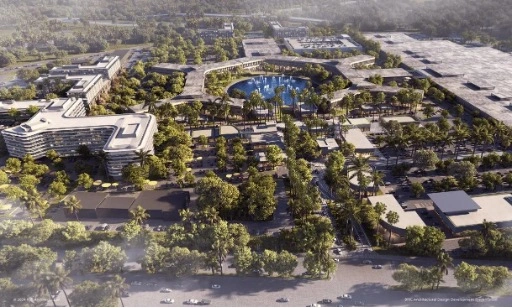
The BRiC master plan appears to be broken up into three sequences, with the first intending to populate the campus’ space with offices, a school, a day care, shops, restaurants, a convention center, a museum, and health and wellness uses.
The campus has leased out 80% of its office space to various companies mostly in the science and technology industries — think engineering firms, financial organizations and medical facilities. It’s also already home to a couple of cafes, a gym and a Baptist Health primary care center.
When exactly these BRiC sequences will begin and end is still unknown, but Martin said the next nine to 10 months will involve Terra “going through a rigorous design process and approval process with the city.”
CP Group, the real estate firm that bought the campus for nearly $180 million in 2018, has said the full build- out won’t be finished for another 10 years, but Martin said the goal is anywhere from six to eight years.
“We’re building this in phases, we’re not building it all at once,” he said. “So this is one phase, this is another phase, and this is another phase here.”
Sequences 2 & 3
The two subsequent sequences propose elements that would add buildings onto the current campus that don’t yet exist at all.
In Sequence 2, the master plan envisions 320 condominiums and 380 apartments with one, two and three- bedroom options.
This sequence also would introduce 140,000 square feet of commercial space, which will be used to bring a grocery store to the campus.
In Sequence 3, 440 more apartments are proposed, also with one- to- three-bedroom offerings. When all is said and done, the campus is expected to have more than 7,000 parking spaces.
“What’s great is that when you have 1.7 million square feet of office that is a built-in infrastructure to really create the energy and life of this place we’re creating, it’s amazing,” Martin said. “And then to be able to introduce a for-sale residential product program and then also for-rent residential program that now can
experience this place, it’s a true mixed-use community.”
The “main arrival” corridor, which is the entrance off Yamato Road that has a view of the existing office
building and BRiC’s 30-foot-tall stainless-steel structure, “Rocket,” is planned to be “framed by a tree-lined, low-rise (one- and two-story) 140,000-square-foot retail village featuring shopping and dining experiences connected by a series of breezeway and pocket parks,” according to the project narrative.
Pocket parks, as described by Terra, are “places for people to pause and chat, enjoy a gelato or admire a piece of public art,” according to the group’s concept design.
Terra also highlighted how BRiC will have an emphasis on events, stating the firm wants to “bake in a variety of event spaces that can be used for buskers or kiosks or events, places that can be programmed or scheduled.”
There also are plans for “an extensive pedestrian and bicycle connectivity network” to create “seamless connections between buildings, amenities and open spaces, as well as direct connections to the Yamato Tri-Rail Station and shuttle stops.”
“Taken together, the BRiC Master Plan will revitalize the existing campus, transforming it from a work-centric environment into a vibrant village where people can live, work, dine and shop,” according to the project narrative.
“Residents and visitors will be actively involved in shaping the quality of their community, while the design prioritizes sustainable beauty by respecting the natural landscape and fostering careful stewardship of the site’s ecology.”